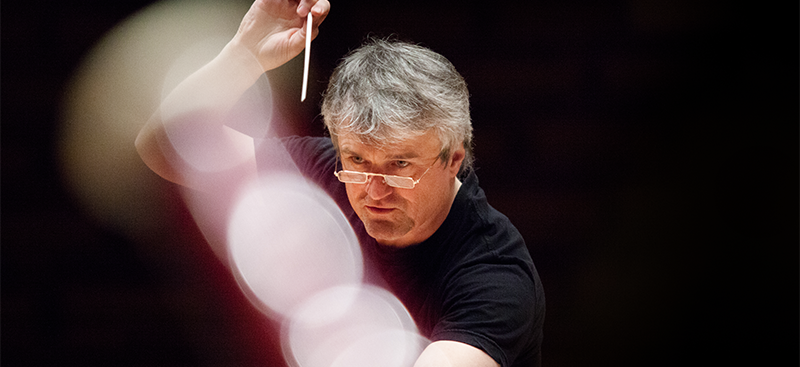
Ingo Metzmacher was General Music Director of the Staatsoper Hamburg from 1997 to 2005, Chief Conductor at Dutch National Opera from 2005 to 2007, and Chief Conductor and Artistic Director of the Deutsches Symphonie-Orchester Berlin from 2007 to 2010. From 2016 to 2025, he served as Artistic Director of the KunstFestSpiele Herrenhausen in Hanover.
Metzmacher is a frequent guest with leading orchestras. He has conducted the Berliner Philharmoniker, Wiener Philharmoniker, Royal Concertgebouw Orchestra, The Cleveland Orchestra, Chicago Symphony Orchestra, Symphonieorchester des Bayerischen Rundfunks, Czech Philharmonic, Orchestre de Paris, Orchestre Philharmonique de Radio France, BBC Symphony Orchestra, Oslo Philharmonic, Swedish Radio Symphony Orchestra, Helsinki Philharmonic Orchestra, Filarmonica della Scala, Wiener Symphoniker and Ensemble Modern, among others. To date, he has also led the Gustav Mahler Jugendorchester on five tours across Europe.
Opera is another major focus of his work. Highlights of recent seasons include new productions of Wolfgang Rihm’s Die Eroberung von Mexico, George Enescu’s Œdipe, Luigi Nono’s Intolleranza 1960, Giuseppe Verdi’s Falstaff and Hans Werner Henze’s Das Floß der Medusa at the Salzburger Festspiele. Further productions include Richard Strauss’ Salome at the Festival d’Aix-en-Provence; Enescu’s Œdipe, Shostakovich’s Lady Macbeth of Mtsensk and Philip Glass’ Satyagraha at the Opéra national de Paris; Walter Braunfels’ Die Vögel at the Bayerische Staatsoper; Albéric Magnard’s Guercœur at the Opéra national du Rhin; and the world premiere of Francesco Filidei’s Il nome della rosa at Teatro alla Scala.
During his tenure as Artistic Director of the KunstFestSpiele Herrenhausen, he brought together the NDR Radiophilharmonie and numerous regional choirs for performances of Arnold Schönberg’s Gurre-Lieder, Hector Berlioz’s Requiem, Gustav Mahler’s Symphony No. 8 and Leonard Bernstein’s MASS. With Ensemble Modern, he also gave the world premiere of Mark Andre’s rwh 1–4.
Metzmacher’s 2026/27 season opens with a return to the Salzburger Festspiele for Hans Werner Henze’s Der Prinz von Homburg. He also conducts Henze’s Voices with Ensemble Modern in Cologne and with Klangforum Wien in Vienna and Madrid. At the Verdi Festival in Parma, he juxtaposes works by Henze with those of Wagner and Debussy. He continues his close relationship with the Opéra national de Paris, conducting the world premiere of Hèctor Parra’s Miroir de nos peines as well as Shostakovich’s Lady Macbeth of Mtsensk. Also in Paris, he returns to the Orchestre Philharmonique de Radio France for the European premiere of Unsuk Chin’s trumpet concerto with Håkan Hardenberger. Elsewhere, he joins the Mahler Chamber Orchestra and Pierre-Laurent Aimard for performances of Messiaen’s Turangalîla-Symphonie in Germany. In Berlin, he pairs works by Lili Boulanger with Stravinsky and Bernstein, while further engagements take him to Reykjavík with Zemlinsky, Brussels with Brahms, Bolzano with Hindemith and Copenhagen with Shostakovich.
His wide-ranging discography includes live recordings of his legendary New Year’s Eve concerts in Hamburg (1999–2004) entitled Who’s Afraid of 20th Century Music?, a complete recording of Karl Amadeus Hartmann’s symphonies with the Bamberger Symphoniker, the world premiere of Henze’s Ninth Symphony with the Berliner Philharmoniker, and Messiaen’s Éclairs sur l’Au-delà… with the Wiener Philharmoniker. More recent releases include a recording of works by Igor Stravinsky with the SWR Symphonieorchester and two recordings with Ensemble Modern: Mark Andre’s cycle riss and Beschenkt – 40 miniatures celebrating the ensemble’s 40th anniversary.
He is also the author of the books Keine Angst vor neuen Tönen [Don’t Be Afraid of New Sounds] and Vorhang auf! Oper entdecken und erleben [Curtain Up! Discovering and Experiencing Opera].
Born in Hanover, Metzmacher studied piano, music theory and conducting in his home city before continuing his studies in Salzburg and Cologne. He found his first artistic home in Frankfurt, where he conducted Ensemble Modern and worked at Oper Frankfurt under Michael Gielen. His international career began in 1988 at Brussels’ La Monnaie, when Gerard Mortier called on him to step in for the new production of Schreker’s Der ferne Klang.